Teaching Digital Literacy in the Age of Generative AI
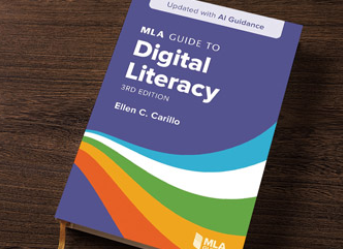
The of Ellen C. Carillo's "MLA Guide to Digital Literacy," with updated AI guidance, was published in March of 2026 by the Modern Language Association. The book contains informational readings (all written by the author, with the exception of two supplementary readings) and exercises for undergraduate students on topics that include algorithmic bias, ethical considerations surrounding AI, and reading laterally. Faculty 四虎影视 composition or research-intensive courses might consider adopting this textbook as a way to introduce their students to the best approaches to evaluating digital sources, along with the possibilities and pitfalls of generative AI. Even those faculty who are 四虎影视 research courses in various disciplines could utilize excerpts from this title in order to introduce students to responsible online research.
The 22-page section on generative AI offers a broad overview of:
- how AI is trained.
- how to prompt AI.
- how to evaluate AI outputs.
- ethical considerations surrounding AI.
This last ethics of AI portion includes readings on "bias in AI models," "data privacy," "deepfakes and the spread of misinformation," "intellectual property," and "environmental impact." These topics, which are each about one page long, offer brief overviews of some of the concerns around AI, though they don't include many datapoints or specific examples, such as statistics on projected data center energy use or particular lawsuits around intellectual property. There are five suggested student exercises at the end of the AI chapter. Each exercise is one paragraph long, with a few reflective questions. One of the exercises asks students to "Create an image of a particular kind of person by entering a prompt (e.g., 'An African American woman,' 'a Jewish boy') into DALL-E, Midjourney, or another image generator powered by AI" and to then reflect on whether the image perpetuates any stereotypes. While these five exercises offer a reasonable amount of breadth, each exercise is quite short and doesn't really examine questions like how to engineer a good prompt in much depth.
For faculty who are looking for a textbook that will deter students from plagiarizing with generative AI, this textbook has disappointingly little to say about that topic. Rather than discouraging students from using AI in composing assignments, the sections on plagiarism contain a kind of boilerplate language: "To avoid inadvertently plagiarizing, you must...understand the rules governing the use of GenAI and similar tools in your classes. Your institution may have a general rule about the use of AI, or individual instructors may be allowed to develop their own policies. Some professors may encourage the use of AI tools (and perhaps require that you acknowledge using them), while others may prohibit AI tools and classify their use as plagiarism." In a book about digital literacy and AI, one might expect more of a discussion of the drawbacks of AI plagiarism, such as the between frequent AI use and poor critical thinking skills.
Nevertheless, for students who are unsure how to undertake online research and evaluate digital sources, this guide offers a lot of helpful and practical information, including:
- the importance of digital literacy.
- how to compose multimodally in digital spaces.
- how to fact check, how to avoid clickbait.
- how (and where) to search for online sources.
- how to investigate an author's credibility.
The information and exercises in this book could provide a great launching point for further in-class discussion and demonstrations on the part of students and faculty of best practices in digital research. Additionally, the book features numerous black and white images that support the text, such as the news source by Ad Fontes Media. There is also a student paper excerpt, a textual example of reading annotations, and two outside readings: "The Polarization of Extremes" by Cass R. Sunstein and "A Real History of Fake News" by John Maxwell Hamilton and Heide Tworek. For faculty who are looking for deeper engagement with the subject matter, the book ends with five sample lesson plans that include additional activities, reflective questions, and exercises on topics such as "Reading Rhetorically with GenAI."
While this title is appropriate for students in composition or research classes, it is important to note that it is not a primer on how to write an essay, and it contains limited information on how to cite and incorporate sources. Supplemental material, such as the website, would need to be used to teach proper citation format for various sources. While this book, as an MLA title, does use MLA citation format, that format is not really a strong topic of instruction in the book, and therefore, this book could be utilized by students in non-MLA fields. For faculty looking to quickly and efficiently introduce their students to practical digital literacy, this title could provide a strong foundation.